The Most Iconic Detroit Brands, and Which Are Still Made Here
· Updated
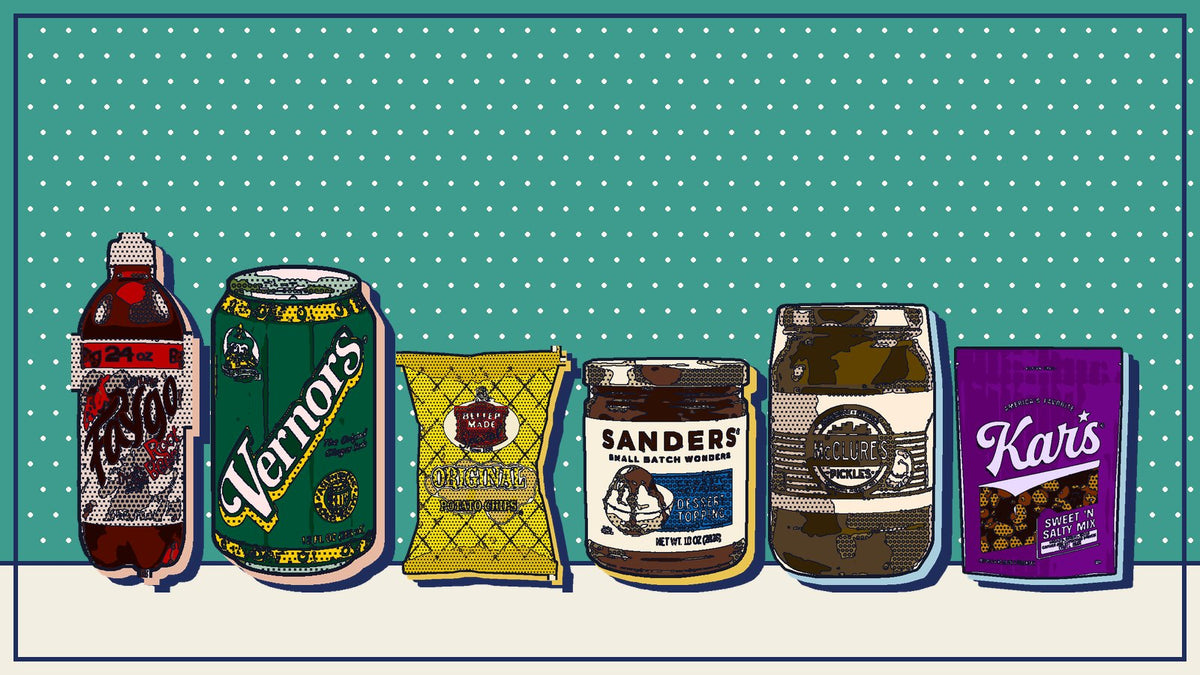
"Made in Detroit" gets printed on a lot of things. For some brands it's literally true: the chips are fried on Gratiot, the pistachios are roasted a few blocks from Eastern Market, the tile is fired in the same East Side building it was fired in 1907. For others it's a birthplace. The company was born here, and the product is now made in Holland, Michigan, or by a contract plant nobody will name.
Both kinds are worth giving. But if you're buying a gift because it's from Detroit, you should know which is which. Here are the brands people most associate with the city, when each started, who owns it now and where it's made, according to the companies and the reporting on them.
The short version
- Still made in Detroit: Faygo, Better Made, Germack, McClure's, Detroit City Distillery, Pewabic, Shinola watches (assembled here).
- Born in Detroit, made elsewhere now: Vernors, Sanders, Stroh's.
- Based in metro Detroit: Kar's, Carhartt.
- Not Detroit, but always on the list: Koegel's, from Flint.
Food and drink
Faygo
Ben and Perry Feigenson, Russian immigrant bakers, started bottling pop in Detroit in 1907 and shortened Feigenson Brothers Bottling Works to Faygo in 1921, according to Faygo's history page. The family sold to TreeSweet, a Texas juice company, in 1986, and TreeSweet sold Faygo a year later to National Beverage Corp. of Fort Lauderdale, the International Directory of Company Histories records. The parent is in Florida. The pop is not. Faygo still labels itself made in Detroit, at its plant on Gratiot Avenue.
Why it matters: More than a century on, it is still bottled in the city where it started. Gift angle: Rock & Rye, by name. Our Rock & Rye story explains the flavor's 1920s origin.
Vernors
James Vernor first served his ginger ale to the public in 1866, according to the Detroit Historical Society. The Vernor family sold the company in 1966, and it passed through several owners before Cadbury Schweppes bought it in 1993. Today it belongs to Keurig Dr Pepper. Production left Detroit when the Woodward Avenue plant closed on Jan. 18, 1985, Historic Detroit records. Gander Newsroom reported in 2024 that Vernors is bottled in Holland, Michigan.
Why it matters: Born in Detroit, still a Michigan drink: Gander reported about 80 percent of sales are in-state. Gift angle: Cans plus a scoop of vanilla, for a Boston Cooler.
Better Made
Better Made began in a garage in 1930 as the Cross and Peters Company, the company's president told Snack Food & Wholesale Bakery this year. It is still family-owned and still makes chips at 10148 Gratiot Ave. on the east side, according to the company, which says it uses locally grown potatoes. Of the brands on this list, it may be the cleanest "made in Detroit" story there is.
Why it matters: Ninety-six years, same city, same family ownership. Gift angle: The Rainbow chips, made from a higher-sugar potato that fries dark. History is in our Better Made story.
Sanders
Fred Sanders opened his candy store at Woodward and Gratiot on June 17, 1875, according to the Detroit Historical Society. The name has moved a lot since. Country Home Bakers bought the company in 1988, and Morley Candy Makers bought the Sanders name and products in 2002. In 2018 Morley merged with Kar's Nuts; the combined company, now called Second Nature Brands and based in Madison Heights, was bought by the private equity firm CapVest in April 2022.
Where it's made is the complicated part. The Sanders factory is in Clinton Township, not Detroit, the company said in 2021. The hot fudge is now produced at an outside facility, after the new owners found the old fudge equipment antiquated, Deadline Detroit reported. The Bumpy Cake was baked for years at Awrey's in Livonia until that bakery closed in 2023; Sanders announced new bakery partners in 2024 without naming them.
Why it matters: No Detroit dessert brand has more memory attached to it. Gift angle: The milk chocolate hot fudge, which ships well. Our Sanders story has a cream puff method.
Kar's Nuts
Sue Kar started roasting peanuts at home in 1933 and sold them outside Navin Field, the ballpark later renamed Tiger Stadium, according to the 2018 announcement of the Kar's and Sanders merger. Kar's is headquartered in Madison Heights and, like Sanders, is part of Second Nature Brands.
Why it matters: A street-corner peanut business that became a Michigan staple. Gift angle: Sweet 'N Salty Mix.
Germack
Germack says it began roasting nuts and seeds in Eastern Market in 1924 and was the first company in America to import and roast pistachios. The family is now in its fourth generation, according to the company. Germack still roasts in Detroit: its plant is at 2140 Wilkins St., and the shop is at 2509 Russell St.
Why it matters: A century of roasting in the same market district. Gift angle: Pistachios, or the cherry and praline nuts. More in our Germack story.
McClure's
Brothers Bob and Joe McClure started selling pickles in 2006 from their great-grandmother Lala's recipe, according to the company. Bob was in New York and Joe was in Detroit, so early production was split between the two cities. The company says it consolidated manufacturing in Michigan in 2009; its plant is on St. Aubin Street in Detroit, across from Hamtramck, where Model D toured it in 2013.
Why it matters: A family recipe that turned into a Detroit factory. Gift angle: The spicy pickles, or the Bloody Mary mix.
Detroit City Distillery
Detroit City Distillery opened its Eastern Market tasting room at 2462 Riopelle St. in 2014, CBS Detroit reported at the time, led by John Paul Jerome and Chuck Gellasch. The company says it was started by eight childhood friends. It makes bourbon, rye, vodka, gin and rum, and also runs a second site it calls The Whiskey Factory.
Why it matters: It makes spirits in Eastern Market from ingredients it says come from farms nearby. Gift angle: A bottle picked up in person at the tasting room. We don't put spirits in our boxes.
Stroh's
Bernhard Stroh started brewing in Detroit in 1850, according to the Detroit Historical Society. During Prohibition the company stayed alive selling near beer, mixers and ice cream. The Gratiot Avenue brewery closed in 1985, and in 1999 the family sold the company to Pabst and Miller. The historical society notes the beer was revived in 2016 with Corktown's Brew Detroit, and that Stroh's Ice Cream, which began as a Prohibition sideline, is still sold.
Why it matters: It was brewed in Detroit for 135 years. Gift angle: Mostly nostalgia now. The Detroit brewery is gone.
Koegel's (Flint)
Koegel's is a Flint company, and it belongs on any list of brands Detroiters miss. Albert Koegel opened in Flint in 1916 and the company has been at 3400 W. Bristol Road since 1972, according to Koegel's. Its natural-casing Viennas are the hot dog Michigan expats ask relatives to bring south. Koegel's doesn't sell its meat online but lists retailers that ship.
Things you can't eat
Carhartt
Hamilton Carhartt started making bib overalls for railroad workers in 1889, with two sewing machines and a handful of employees, according to the Detroit Historical Society. The company is still family-owned by his descendants and headquartered in metro Detroit, where its product design happens. It runs a Detroit store on Cass Avenue in Midtown with a community workspace upstairs. If "made in" matters to the person you're buying for, check the label on the specific piece.
Why it matters: A 137-year-old family company that never left the region. Gift angle: A watch cap or a chore coat, bought on Cass.
Shinola
Shinola was founded in 2011 in Detroit, according to the company. It was launched by Bedrock Manufacturing, the investment firm of Fossil co-founder Tom Kartsotis, Europa Star reported in 2019. That same report found about 100 employees assembling every watch at Shinola's Detroit headquarters, using Swiss movements from Ronda and Sellita. Assembled here, with Swiss parts inside, is the accurate description.
Why it matters: It built a national retail brand around a Detroit address; Europa Star counted 28 Shinola stores and more than 500 other retailers in 2019. Gift angle: A watch for a milestone; a leather journal for a smaller one.
Pewabic Pottery
Mary Chase Perry Stratton and Horace Caulkins started Pewabic in 1903 in a carriage house in Brush Park, according to Pewabic. In 1907 it moved to an East Side studio designed by architect William Buck Stratton, and that building is still in use. Michigan State University took over the pottery in 1965, and the nonprofit Pewabic Society has run it since 1981.
Why it matters: Its iridescent tiles are set into buildings across southeast Michigan, and it still makes them in Detroit. Gift angle: A single tile. It's small enough to mail and it'll outlast everything else on this list.
Putting a few in one box
Most of the food brands above travel well. The 313 Box ($79) has Better Made, Faygo Rock & Rye, Vernors, Sanders hot fudge and Germack nuts, packed by hand in Detroit. If you'd rather pick your own, the build-your-own box starts at $49 for four items.
A note on what you won't find in our boxes: team logos. Detroit's sports brands belong to the teams, so we leave them out.